 Skip to content
Medical-Grade Skincare · Kensington, London
Home / Skin Care Treatment
Medical-Grade Skincare in London, Chosen for Your Skin — Not Sold Off a Shelf
Medical-grade skincare is skincare built on bioactive ingredients at concentrations able to change how skin cells behave, which is why it is dispensed through a clinic after an assessment. At Faciem Dermatology & Medical Clinic in Kensington the main line is ZO Skin Health®, and each programme is put together around your diagnosis, your skin type and the one thing you most want changed.
Every programme begins with a skin consultation of 45–60 minutes, free with the skin therapist or £150 with Dr Prasad. Where a plan needs prescription products, those are prescription-only medicines: they follow a face-to-face consultation with Dr Prasad and can be dispensed no other way.
- ZO Skin Health programmes
- Assessed before dispensing
- Reviewed every 6–12 weeks
- Kensington Church St

96%
Patient satisfaction
- Medically reviewed by Dr Prasad
This page sets out how skincare programmes are assessed, dispensed and reviewed at Faciem, and is checked for clinical accuracy.
Last reviewed: 15 September 2026.
Patient information only. Products are dispensed after a skin assessment, and prescription items require a face-to-face consultation with Dr Prasad.
Patients since 2019
Procedures
Satisfaction
TL;DR
Medical-grade skincare at Faciem is dispensed after a skin consultation of 45–60 minutes, which is free with the skin therapist and £150 with Dr Prasad. The main line is ZO Skin Health, alongside Colorescience®, Heliocare® and prescription products. Results can start from about two weeks and become more noticeable by six. Programmes are reviewed every six to twelve weeks so stronger agents can be added as your skin tolerates them, and repeat orders go through the clinic portal or by email.
- Dispensed after a skin assessment
- Free with the therapist, £150 with Dr Prasad
- Reviewed every six to twelve weeks
Treatment at a Glance
Medical-Grade Skincare at a Glance
Consultation time
45–60 minutes
Your skin is examined and the whole programme planned and explained inside that appointment.
Price
Free with the skin therapist
A consultation with Dr Prasad is £150. Products are charged separately and priced for you before you buy.
Results visible
From about two weeks
More noticeable by around six weeks, depending on the concern being treated.
Results last
While the programme continues
Topical results hold for as long as the products are used, and reviews every six to twelve weeks keep the programme matched to your skin.
Downtime
Peeling is possible
Some retinols and acids can cause peeling, which is discussed with you at the consultation.
Back to work
Work is not affected
Products are used at home, so there is no procedure to recover from.
*Consultation prices are a guide and are confirmed before booking. Products are charged separately, every product provided at the clinic requires a consultation first, and prescription items require a face-to-face consultation with Dr Prasad.
About the Treatment
What Is Medical-Grade Skincare and How Does It Work?
What separates medical-grade skincare from a high-street routine is not the label on the bottle. It is what reaches living skin, and at what strength.

Medical-grade skincare means products containing bioactive agents at concentrations able to alter cellular function, dispensed through a clinic after a skin assessment and not sold over the counter. What a programme achieves depends on which actives suit your particular concern and how well the formulation carries them to the depth the skin needs them.
Why a shelf product and a clinic product are not the same
Results in skin come down to two things: which active ingredients are used for your concern, and how well those actives are delivered. Both are set by the chemical formulation of the product. Pharmaceutical and medical regulations limit what may be sold over the counter in a pharmacy or a department store, so a product on general sale is not permitted to be truly bioactive.
A bottle labelled 10% retinol on a shop shelf therefore cannot be assumed to deliver 10% at the depth where the skin needs it. Agents able to alter cellular function are by their nature medical grade, and obtaining them usually means seeing a skin specialist. The trade-off is real: stronger actives do more, and they also need supervising.
Why the consultation comes before the products
Every skincare product provided at Faciem follows a consultation. Part of that is matching the active to the diagnosis. Part of it is sequence and pace, because the same retinol that suits one person will irritate another if it is introduced too fast or alongside the wrong acid.
Skin tone is part of that assessment. Skin is graded on the Fitzpatrick scale, I to VI, and the grade changes how a programme is built. In deeper skin tones — Fitzpatrick IV to VI — the risk being managed is post-inflammatory hyperpigmentation: an active strong enough to irritate can leave a brown mark that outlasts the irritation by months. Medical-grade skincare suits every skin tone, and pigment-directed agents are often the whole point of the programme; what changes is the starting strength, how slowly each active is introduced and how firmly daily sun protection is built in around it.
For mild to moderate pigmentation, Dr Prasad is the appointment to book. For other concerns you can see the skin therapist, who assesses your skin thoroughly and can refer you on to Dr Prasad for a medical dermatology consultation if that is appropriate and you are happy to. The therapist is experienced, but she cannot start you on prescription products: prescription-only medicines require a face-to-face consultation with a prescribing doctor.
What a skincare programme is like day to day
A skincare programme is a daily routine, not an appointment, so it fits around normal life and work is not affected. The part that needs warning is the adjustment period. Some retinols and acids can cause peeling, and Dr Prasad or the therapist talks that through with you at the consultation before you start.
Results can begin as early as two weeks and become more noticeable by around six. Reviews are recommended every six to twelve weeks, and their purpose is to add stronger agents as your skin tolerates them, so the programme keeps progressing. Skin changes with the seasons, with age and with treatment; a programme nobody adjusts stops matching it.
The skincare lines dispensed at Faciem
The main line at Faciem is ZO Skin Health, formulated in California. Dr Prasad sits on the ZO Skin Health UK Faculty and trains other practitioners in the range, which is why the range is used here in depth and not stocked as one option among many. Our ZO Skin Health page covers the range in more detail.
Alongside it the clinic dispenses Colorescience, Heliocare and prescription products. Nothing is stocked simply to widen the shelf. An initial purchase can look expensive next to a supermarket routine, and the honest comparison is not bottle against bottle but what each is capable of changing over three months.
Where skincare fits alongside clinic treatments
Medical-grade skincare does much of the work on its own, and for several concerns it is the whole plan. It is also what holds the result of a clinic procedure in place, so it runs alongside treatment and not instead of it.
Where a peel is planned, our chemical peels page explains how skincare prepares the skin beforehand and protects the result afterwards, and the same preparation applies to the deeper TCA peels. Programmes are built just as often for people having no procedure at all. What suits you is decided at your consultation, and outcomes differ from one person to the next.
Concerns, Appointments & Brands
What Can a Skincare Programme Treat?
Skincare programmes at Faciem are built for ageing skin across all skin types, acne, rosacea, melasma and oily skin, in men and women alike. The actives differ for each: what calms rosacea is not what clears acne, and pigmentation needs agents that act on the cells producing it. That is the reason skin is assessed before anything is dispensed.
ZONE I
Concerns treated
What skincare programmes are most often built around.
Ageing skin, all skin types
Anti-ageing programmes suit all skin types and usually pair a retinol with daily sun protection. Results vary with age, skin type and how consistently the routine is followed.
Acne and oily skin
Rosacea
Rosacea-prone skin has a compromised barrier and reacts to products that suit other skin types, so a rosacea programme is built to calm the skin, not to strip it.
Melasma and pigmentation
Melasma and other pigmentation respond to topical treatment, and daily sun protection forms part of every pigmentation plan. For mild to moderate pigmentation the clinic recommends an appointment with Dr Prasad.
ZONE II
Who you see
Two ways in, depending on what your skin needs.
The skin therapist
A free consultation covering a thorough assessment of your skin, with referral on to Dr Prasad where that is appropriate and you are happy to. The therapist cannot start prescription products.
Dr Prasad
A consultation with Dr Prasad is £150 and is the route for mild to moderate pigmentation and for anything that may need a prescription.
ZONE III
The lines we dispense
Chosen deliberately, and used in depth.
ZO Skin Health
The clinic’s main line, formulated in California. Dr Prasad is a member of the ZO Skin Health UK Faculty and a trainer for the range.
Colorescience
Stocked at the clinic and used where it fits your programme, which is a decision taken at your consultation and not at a counter.
Heliocare
Also stocked at the clinic. Daily sun protection matters most where pigmentation is being treated, since sunlight undoes the work.
Prescription products
Used where a programme needs them. These are prescription-only medicines, so a face-to-face consultation with Dr Prasad comes first.
Choosing the Right Treatment
Medical-Grade vs Over-the-Counter Skincare: What’s the Difference?
Medical-grade and over-the-counter skincare differ in what each is permitted to contain and in how each reaches you. Regulations cap how bioactive a product sold on general sale may be, whatever percentage the label carries. Clinic products are stronger, which is precisely why they are assessed, explained and reviewed, never simply sold.
| Medical-grade skincare | Over-the-counter skincare | |
|---|---|---|
| How it works | Bioactive agents at concentrations able to alter cellular function, dispensed after a skin assessment. | Formulated for general sale, where regulations limit how bioactive a product may be. |
| Best for | Acne, rosacea, melasma and pigmentation, oily skin and ageing skin. | Cleansing, hydration and general upkeep of comfortable skin. |
| Results appear | From about two weeks, more noticeable by six. | Varies by product; not something we can state for products we do not dispense. |
| Results last | As long as the programme is followed, with reviews every six to twelve weeks keeping it current. | Depends on continued use, as with any topical routine. |
| Downtime | Some retinols and acids can cause peeling, discussed before you start. | Generally none, which is the other side of being less active. |
| Ideal candidate | Someone with a diagnosed concern who wants a programme built for it and adjusted as their skin changes. | Someone with comfortable skin and no specific concern to correct. |
Results vary between individuals, and stronger is not automatically better. Dr Prasad will tell you when the routine you already own is doing its job, and when a concern needs treatment rather than another product.
Transparent Pricing
How Much Does Medical-Grade Skincare Cost at Faciem?
A skin consultation with the skin therapist is free, and a consultation with Dr Prasad is £150. Products are charged separately, and what you spend depends on how many actives your programme needs and how often each is replaced. Every product is priced for you at the consultation, so the cost of the whole programme is clear before you buy any of it.
Skincare is the hardest thing in aesthetics to price-compare honestly, because two bottles that look alike can differ entirely in what they deliver. The useful question is what a product is capable of changing over three months, and whether anyone is checking that it did. A cheaper routine that changes nothing is not the better value.
Once you are on a programme, repeat orders go through the clinic’s website portal or by email, so restocking does not need another appointment. What keeps a programme worth paying for is the review that follows it.
| Treatment | Price |
|---|---|
| Skin consultation with the skin therapist | Free |
| Skin consultation with Dr Prasad | £150 |
| ZO Skin Health and other products | Priced at your consultation |
| Review appointment, every six to twelve weeks | Confirmed when you book |
Why Faciem
Why Choose Faciem for Medical-Grade Skincare?
Anyone can sell you a bottle. What changes the outcome is the right active for your diagnosis, introduced in the right order, and reviewed by someone who will change it when your skin changes. Dr Prasad is a GMC-registered doctor with 20 years’ experience in dermatology and aesthetics, and she sits on the ZO Skin Health UK Faculty.
- Products dispensed after a skin assessment, never handed across a counter
- Prescription products available following a face-to-face consultation with Dr Prasad
- Programmes reviewed every six to twelve weeks and strengthened as your skin allows
- ZO Skin Health UK Faculty and Trainer, so the range is used in depth
- A free consultation with the skin therapist if you are not sure where to start
- Reordering through the clinic portal or by email once you are established
Experience & Expertise
Why It Matters Who Chooses Your Products
Skincare tends to fail for predictable reasons: an active the skin never needed, the right active introduced too fast, or three products quietly working against each other. Strong ingredients are unforgiving of guesswork, and most of the routines circulating online were built for somebody else’s skin and somebody else’s diagnosis.
Dr Prasad examines the skin, names the concern, builds the programme around it and then reviews it as your skin adapts. She is a member of the ZO Skin Health UK Faculty and a trainer for the range, and she can prescribe where a programme needs prescription-only treatment. Her profile sets out her training and practice.
- Dr Anamica Prasad — MBChB (1999), Dip Dermatology (2001), MRCGP, DFFP, DRCOG · a GMC-registered doctor
- Member of the Joint Council for Cosmetic Practitioners (JCCP), British Medical Laser Association (BMLA), Royal Society of Medicine and the Aesthetic Complications Group · ZO Skin Health UK Faculty & Trainer
- Clinic operated by Derma Medical UK Ltd — registered with the Care Quality Commission (CQC) for diagnostic and screening procedures, surgical procedures, and treatment of disease, disorder or injury (Location ID 1-25573003746)
- Face-to-face medical consultation before any prescription-only product is prescribed
- 20 years’ experience in dermatology and aesthetics, prescribing skincare across every skin type

Patient Reviews
Rated Excellent by Patients on Google
Your Journey, Our Promise
From First Consultation to Ongoing Programme
A skincare programme at Faciem starts with an examination of your skin, not with a product recommendation. The consultation runs 45–60 minutes, and every product dispensed at the clinic requires one. What comes out of it is a routine that is reviewed and adjusted as your skin changes.
STEP 01
Consultation
Book with the skin therapist, whose consultation is free, or with Dr Prasad at £150. Mild to moderate pigmentation, and anything likely to need a prescription, belongs with Dr Prasad.
STEP 02
Personalised programme
You leave with a programme naming each product, when to apply it and in what order, matched to your concern and your skin type. Any peeling likely from retinols or acids is explained before you begin.
STEP 03
Starting the actives
Actives are introduced at a pace your skin can tolerate, one step at a time. Work is not affected, and results can begin from around two weeks, becoming more noticeable by six.
STEP 04
Review & reorder
Reviews every six to twelve weeks are where stronger agents are added as your skin allows. Once you are established, repeat orders go through the clinic portal or by email, and the cost of a review appointment is confirmed when you book it.
Side Effects & Safety
What Are the Side Effects of Medical-Grade Skincare?
Medical-grade skincare is more active than a high-street routine, so a period of adjustment is normal and not a sign that something has gone wrong. Most patients describe it as tightness, a mild sting for a minute or two after a retinol goes on, and some flaking — concentrated in the first two to six weeks while the skin adapts. It is usually settled by dropping a retinol to every second or third night for a fortnight, not by abandoning the programme.
Common, temporary effects
- Peeling or flaking, particularly from retinols and acids
- Dryness and a tight feeling in the first few weeks
- Redness or mild stinging as the skin adjusts to a new active
- Greater sensitivity to sunlight, which is why daily sun protection is part of the plan
Uncommon effects
- Less commonly, irritation persists beyond the adjustment period, or a product does not suit your skin and the programme is rebuilt around a different active. Contact dermatitis is possible with any topical product. Contact the clinic before pushing through: skincare that keeps irritating your skin is not working, and adjusting the strength or the frequency usually settles it.
Who a skincare programme is not for
- Retinoids are generally avoided in pregnancy and while breastfeeding, so tell the clinic if either applies and the programme will be built without them. Skincare alone is also not the answer to every concern, and Dr Prasad will say when a diagnosis, a procedure or prescription treatment is what your skin actually needs. Suitability is assessed individually.
Using Your Programme
How to Get the Most From Your Skincare Programme
A skincare programme rewards consistency more than enthusiasm, and the arc is fairly predictable. Weeks one to six are the adjustment period, when dryness and flaking are commonest. By around six weeks tone and texture usually begin to shift. The review at six to twelve weeks is where stronger agents go in, and from there the programme moves in steps rather than jumps. Programmes come unstuck for three reasons: sporadic use, extra products nobody at the clinic knows about, and stopping during those first six weeks.
Do
- Apply in the order and at the frequency you were given, and introduce one new active at a time, roughly two weeks apart
- Wear broad-spectrum SPF 50 every morning and reapply every two hours outdoors, which matters most while pigmentation is being treated
- Keep the review appointment every six to twelve weeks, since that is when stronger agents can be added
- Reorder through the clinic portal or by email about two weeks before a product runs out, so the routine is not interrupted
- Tell the clinic if a product stings, flakes or breaks you out beyond the first six weeks
Avoid
- Scrubs, home peels or extra acids on top of the programme, which turns two weeks of adjustment into two months of irritation
- Stopping a retinol at the first flake — most adjustment settles within four to six weeks, so ask before you stop
- Someone else’s prescription products, or a prescription of your own that has not been reviewed in six months
- Sunbeds at any stage, and midday sun between 11am and 3pm without protection while you are using retinols or acids
- Carrying on with a routine bought five years ago, or a programme nobody has looked at in more than twelve weeks
This is general guidance and does not replace the personalised instructions given with your programme, which depend on the products you are using and how your skin responds to them.
Skincare FAQs
Your Questions, Answered
Answers to what patients ask before starting a programme, and to the practical questions that follow it — makeup, timing around an event, peeling and how often the plan is reviewed.
How much does medical-grade skincare cost in London?
At Faciem the skin therapist consultation is free and a consultation with Dr Prasad is £150. Products are charged separately: what you spend depends on how many actives your programme needs and how often each is replaced, and every item is priced for you at the appointment. Nothing is dispensed before the cost has been agreed.
What is medical-grade skincare?
Medical-grade skincare contains bioactive agents able to alter cellular function, at concentrations regulations do not permit in products sold over the counter. Because those actives are stronger, medical-grade products are dispensed through a clinic after a skin assessment, and some of them are prescription-only medicines.
Do I have to see the doctor, or can I see the skin therapist?
For mild to moderate pigmentation, Faciem recommends seeing Dr Prasad. For other skin concerns you can book with the skin therapist, who makes a thorough assessment of your skin and can refer you on to Dr Prasad for a medical dermatology consultation if that is appropriate and you are happy to. Only Dr Prasad can start you on prescription products.
Can I wear makeup while using medical-grade skincare?
Yes. Makeup goes on as usual once your morning products have absorbed, which takes two or three minutes. During the first six weeks, when flaking is commonest, a mineral formulation sits better over dry patches than a heavy liquid base, and the clinic dispenses Colorescience mineral makeup, which carries broad-spectrum sun protection and so counts towards the SPF a pigmentation programme needs. Remove it at night with your prescribed cleanser instead of a wipe or a scrub.
Can I just order the products online?
Not to begin with. Every skincare product provided at the clinic requires a consultation first, including for patients who have used ZO products elsewhere, because the same product can be recommended very differently from one skin to the next. After your consultation you are shown how to reorder through the portal or by email.
How long before I see results from medical-grade skincare?
Results can start as early as two weeks and become more noticeable by around six weeks. Pigmentation and acne usually take longer to settle than dryness or dullness. Results vary between individuals, and consistency matters more than the strength of any single product.
How often do I need a review appointment?
Every six to twelve weeks. Reviews are where stronger agents are added as your skin tolerates them, which is what keeps a programme progressing when it would otherwise stall. The cost of a review appointment is confirmed when you book it.
Will medical-grade skincare make my skin peel?
It can. Some retinols and acids cause peeling, and that is discussed with you at the consultation before you start. Peeling generally settles as the skin adapts, and the strength or the frequency can be adjusted if it is more than you want to live with. Work is not affected while it happens.
Can a skincare programme treat acne and oily skin?
Yes. Acne and oily skin are both among the concerns treated with skincare programmes at the clinic. Where acne is more than mild, Dr Prasad may add prescription treatment following a face-to-face consultation, and our acne treatment page sets out what else can be combined with a programme.
Can skincare help melasma and pigmentation?
Medical-grade skincare is used to treat melasma and other pigmentation, and for mild to moderate pigmentation the clinic recommends seeing Dr Prasad. Daily sun protection is part of any pigmentation plan, because sunlight drives the pigment back. Melasma tends to recur and is managed over time, not resolved once.
How long before a wedding or event should I start a skincare programme?
Allow eight to twelve weeks before the date. Results can begin from about two weeks and become more noticeable by six, and starting that far ahead leaves the adjustment period — the first six weeks, when retinols and acids may cause flaking — well behind you. It also fits in one review appointment at the six-to-twelve week mark. The one thing to avoid is starting a new active in the fortnight before an event.
Can I use medical-grade skincare during pregnancy or breastfeeding?
Tell the clinic if you are pregnant or breastfeeding, and the programme will be built without retinoids, which are generally avoided at both times. What a routine can include instead, cleansing and daily sun protection among it, is decided with you at the consultation. Suitability is assessed individually.
Medical-Grade Skincare in Kensington, London
A Doctor-Led Clinic in the Heart of Kensington
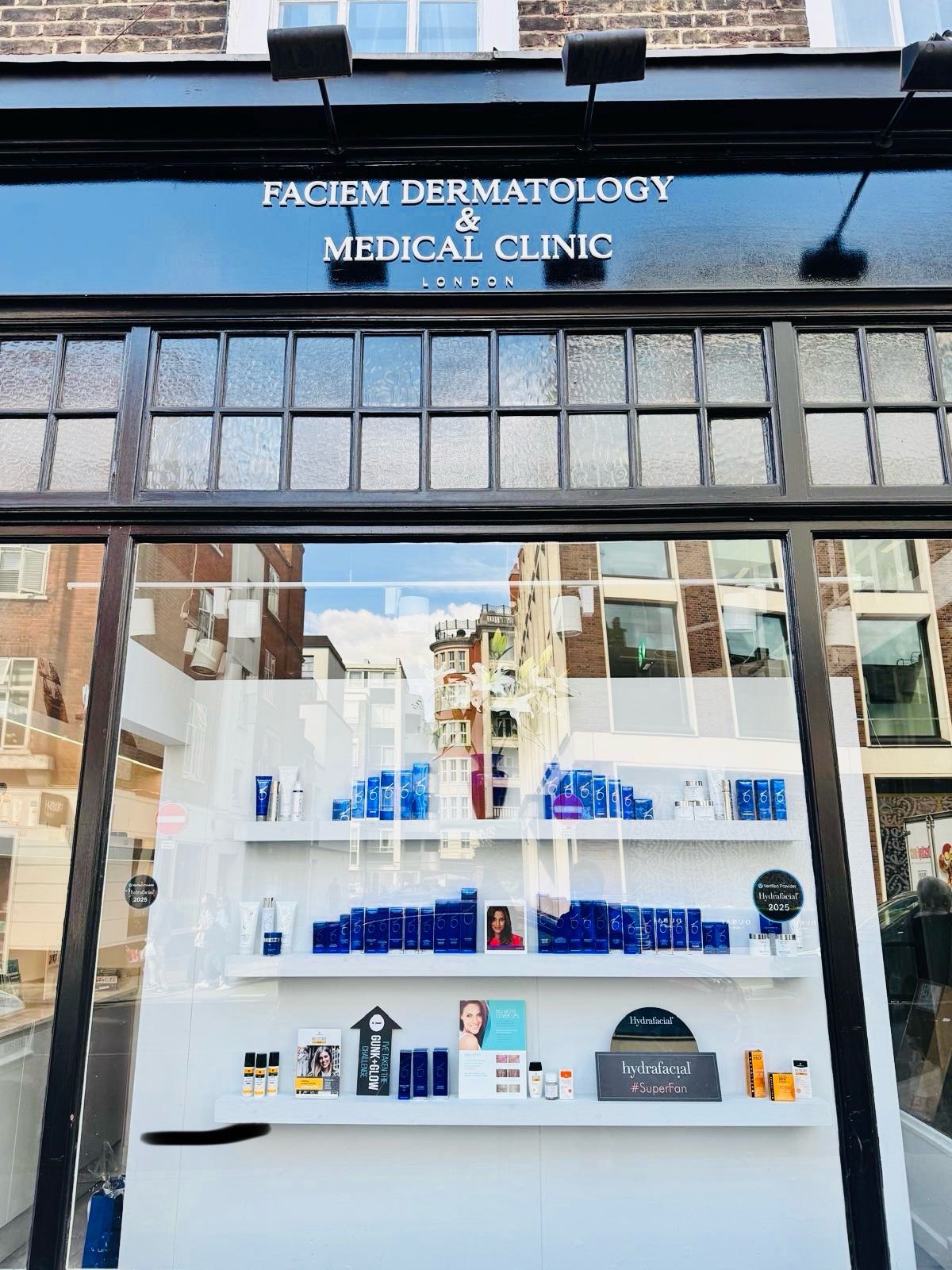
Medical-grade skincare is dispensed at Faciem Dermatology & Medical Clinic on Kensington Church St, London, under Dr Prasad. The clinic sits between two Underground stations: High Street Kensington is a few minutes away on foot, Notting Hill Gate roughly ten, and the Kensington council underground car park is close by if you drive. Most people on a programme live or work across west and central London, though restocking through the portal means the journey is only needed for consultations and reviews.
A skin consultation takes 45–60 minutes and needs no recovery time, so it sits comfortably in a lunch hour or an early evening. The clinic is open Monday to Saturday, 10am–7pm, and closed on Sunday. Reviews are booked every six to twelve weeks; between them, repeat orders go through the portal or by email.
Skincare is unusually easy to buy badly, because the same vocabulary appears on a £30 serum and on a prescription. Before you spend, find out whether anyone examines your skin first, whether the person advising you is registered with the GMC, NMC or GDC and can prescribe if your skin needs it, and whether the full cost of a programme is set out before you commit to it. At Faciem the answer to each of those is yes.
A consultation puts you under no obligation to buy anything. If the routine you already own is doing its job, or your skin needs a diagnosis before it needs a product, that is what you will be told.
Plan Your Visit
- Faciem Dermatology & Medical Clinic
- Phone: +44 20 7131 3539
- 7 Kensington Church St, London W8 4LF, United Kingdom
- Tube: High Street Kensington (few minutes’ walk) · Notting Hill Gate (~10 minutes)
- Parking: Kensington council underground car park nearby
- Open Monday–Saturday, 10am–7pm · Sunday closed
- Skin consultations bookable online with the therapist or with Dr Prasad
- Consultation-first — no treatment without medical assessment
- Serving Kensington, Chelsea, Notting Hill & Central London
Continue Exploring
Related Treatments & Reading
All Aesthetic Treatments
Explore the full range of doctor-led skin and aesthetic treatments available at Faciem, from injectables to medical-grade skincare.
Skin Health Blog
Expert articles from the Faciem team on skin ageing, treatment advice and how to get the best from your skincare.
Faciem Dermatology & Medical Clinic · Kensington
Find Out What Your Skin Actually Needs
Book a skin consultation to have your skin examined and a programme planned around what you want changed, with every product and every cost explained before you buy. If you would like to hear from people treated here first, read our patient reviews.
Prefer to talk? +44 20 7131 3539